Initiative roles
Within an initiative, every member has a role. A role is a reusable bundle of permissions that decides which kinds of tools a person can use here. Roles save you from setting permissions person by person — you describe the kind of member once, then assign it.
How roles fit with sharing
It helps to separate two different questions:
- Roles answer "what kinds of things can this person do in this initiative?" — for example, "can they create projects, or only view them?"
- Sharing answers "can this person see this specific project or document?" — covered in Sharing projects & documents.
Both apply. A role might let someone create documents in general, while an individual document is still only visible to the people it's shared with.
The permissions a role can grant
Permissions are grouped by tool. For each tool, a role can typically allow viewing, creating, or neither:
| Tool | Permissions |
|---|---|
| Projects | View, Create |
| Documents | View, Create |
| Queues | View, Create |
| Counters | View, Create |
| Events (calendar) | View, Create |
| Dashboards | View, Create |
So a "Contributor" role might be allowed to view and create projects and documents, while a "Guest" role can only view them, and has no access to queues or counters at all.
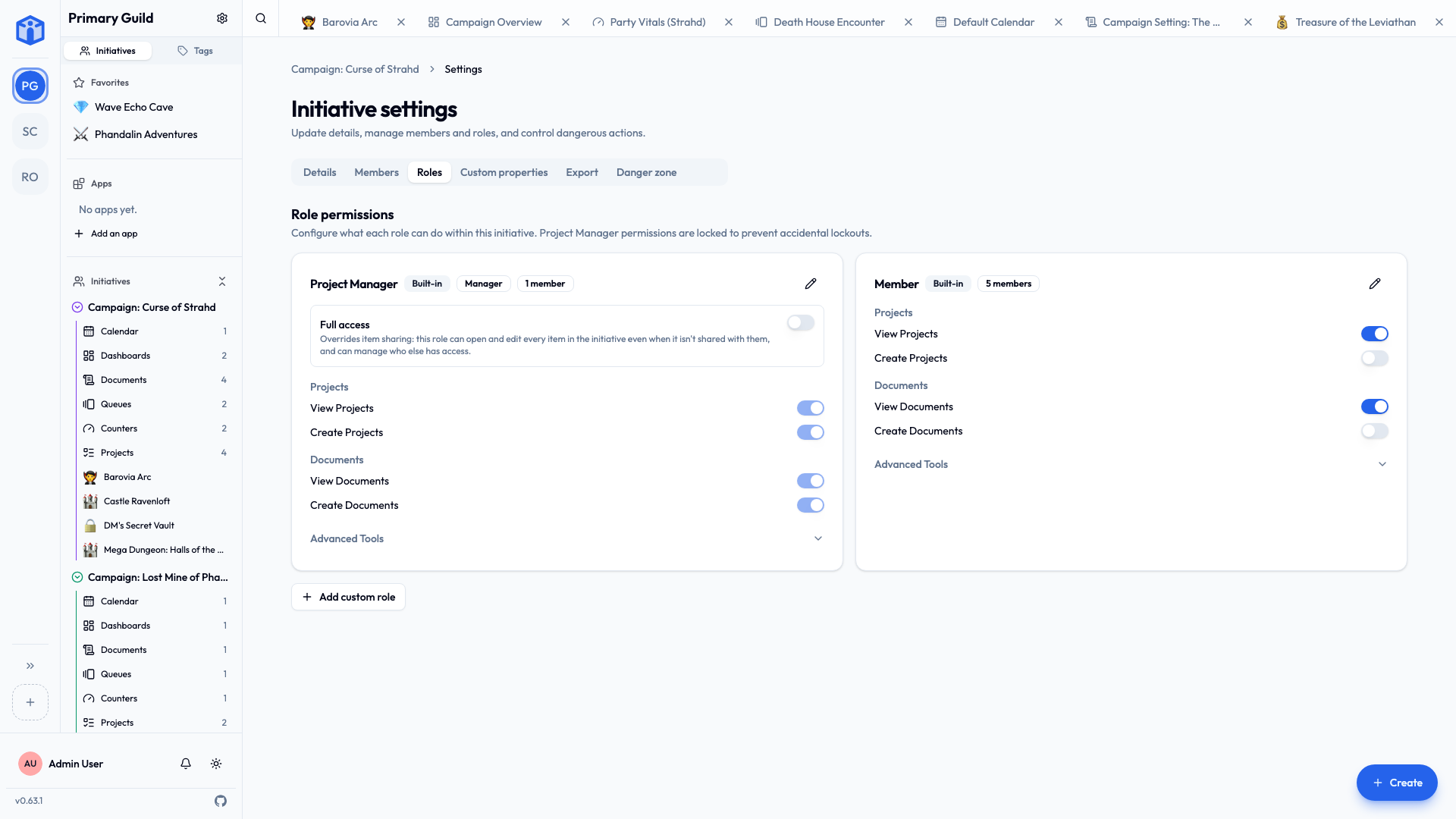
The built-in Manager role
Every initiative includes a Manager role (also called the project manager, or PM). It's the lead role: its permissions are fixed and broad, and whoever creates an initiative starts as its Manager.
The Manager role is also the only role with full access — Managers can reach everything in the initiative, including projects and documents that were never shared with them individually. This override belongs to Manager alone; no other role, built-in or custom, can be given it.
Managers see everything — choose them carefully
Because the Manager role overrides per-item sharing, anything kept private to a few people is still visible to a Manager. Give the Manager role only to the few people who genuinely need the whole picture.
Creating your own roles
Beyond Manager, you can create roles that match how your group actually works:
- Open the initiative's settings → Roles.
- Add a role and give it a name your group will recognize ("Director," "Cast," "Editor," "Observer").
- Tick the permissions it should have.
- Save. The role is now available when you add or edit members.
Name roles for people, not permissions — "Volunteer" is friendlier and clearer than "View-only contributor."
Assigning roles to members
When you add a member to an initiative, you choose their role. You can change someone's role later from the same Members settings. Changes take effect right away.
Related
- Sharing projects & documents — the final, per-item layer.
- Working with initiatives — creating initiatives and adding members.